This comparison is not “contract versus no contract”. It is a handset-inclusive route versus acquiring the phone separately and paying for airtime on its own terms.
Scope of this page: This comparison answers one narrow question: handset-inclusive contract versus obtaining the phone separately and using SIM-only. It should not be read as a general iPhone-versus-Android or cheapest-phone ranking.
Build both columns
| Line | Handset-inclusive route | Phone plus SIM-only |
|---|---|---|
| Phone | All device payments and upfront amounts | Cash price or separate finance total |
| Airtime | Every core subscription payment | Every SIM payment |
| Price changes | Apply stated rises by date | Apply stated SIM changes by date |
| Ownership | Check the device agreement | Usually follows the purchase or finance terms |
| Exit | Airtime charge plus any device balance | SIM exit plus separate finance position |
| Residual value | Same exact phone assumption | Same exact phone assumption |
Illustrative result
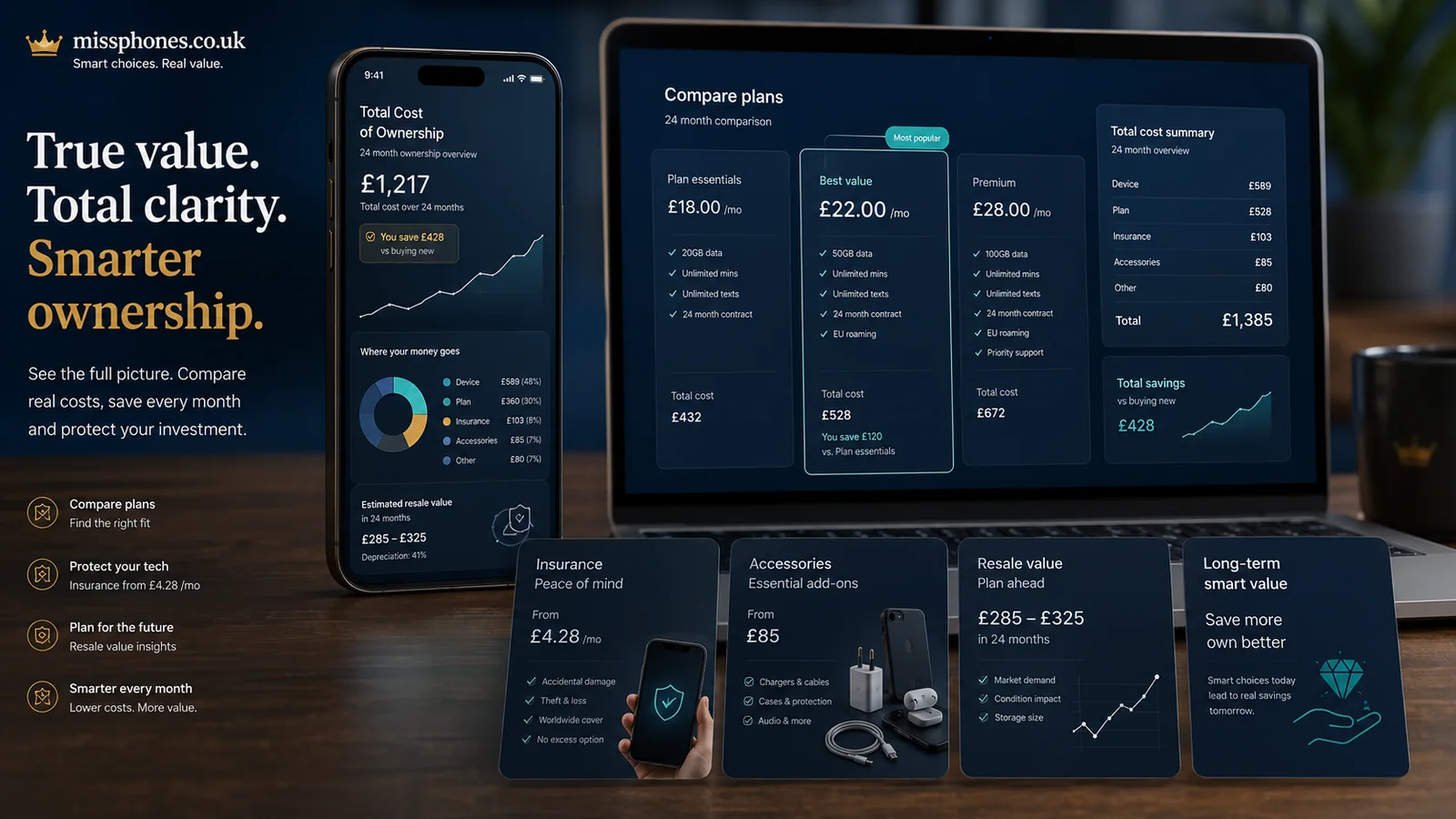
A handset-inclusive route might total £1,260 over 36 months. Buying the phone for £610 and using a £10 monthly SIM totals £970 before finance cost. If the separate phone is financed to £690, the comparison becomes £1,050. These are illustrative figures.
Compare documents, not labels
Some providers separate airtime and device plans; others structure the transaction differently. Confirm lender, ownership, settlement and minimum terms from the actual documents.
Value flexibility
A separate phone and short SIM plan can make switching easier, but only if the phone purchase is affordable. A bundled route can be competitive when the whole-term price is genuinely lower and the terms suit the user.
Cash-flow and total cost are different
The cheaper total may require a larger upfront payment. Compare affordability without allowing a low monthly figure to hide a higher whole-term cost, and without recommending an upfront purchase that would remove necessary emergency savings.
Repeat the calculation when the allowance differs
A handset-inclusive plan with 100GB is not directly comparable with a 10GB SIM if the user needs 40GB. Normalise the allowance or assign a clear value to the difference.
Guides connected to Total Cost of Ownership: Contract vs SIM-Only
Useful official references: Total Cost of Ownership: Contract vs SIM-Only
Putting Total Cost of Ownership: Contract vs SIM-Only into practice
- Exit and flexibility:check minimum term, early-exit consequences, upgrade mechanics and what happens to the handset at the end, with the total cost ownership contract vs case in mind. In practice, a low monthly figure can hide a long inflexible commitment when assessing Total Cost of Ownership: Contract vs SIM-Only.
- Coverage before price:a cheap tariff has little value if it does not work where you regularly need it, with the total cost ownership contract vs case in mind. For this page on Total Cost of Ownership: Contract vs SIM-Only, use current coverage information and, where practical, real-world experience in the places that matter.
- Full commitment:add upfront charges and every required monthly payment over the minimum term, including any clearly stated scheduled price changes for the decision described here.
- Device and airtime are different costs:separate what you are paying for the handset from network service where possible, with the total cost ownership contract vs case in mind. For this scenario, this makes a contract comparable with an outright phone plus SIM-only route when assessing Total Cost of Ownership: Contract vs SIM-Only.