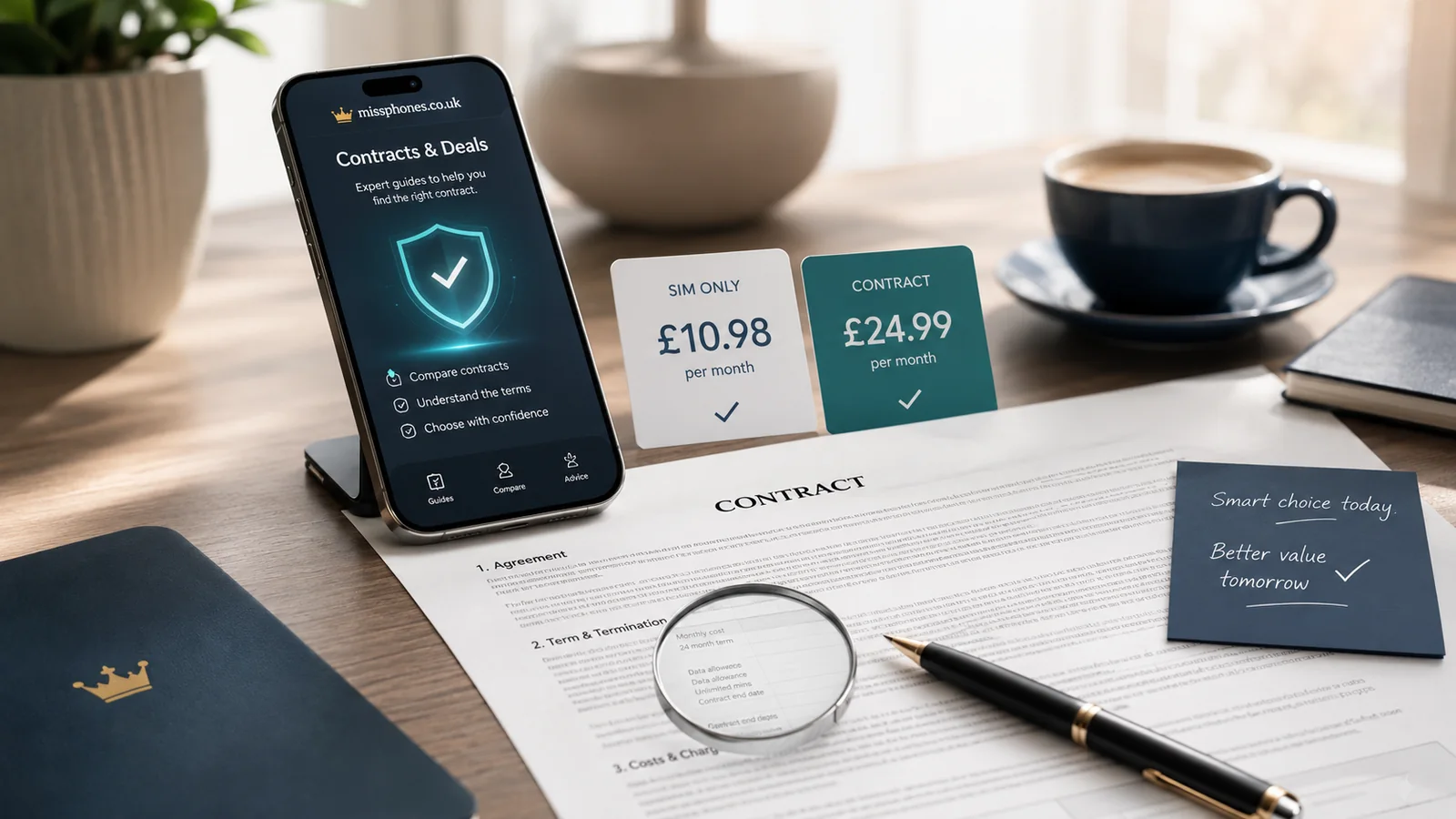
Buying outright gives you a clear handset price and immediate flexibility. A contract spreads the commitment and may include a genuine discount. The better option is the one with the lower suitable total and the safer cash flow — not automatically one route or the other.
Compare the same package
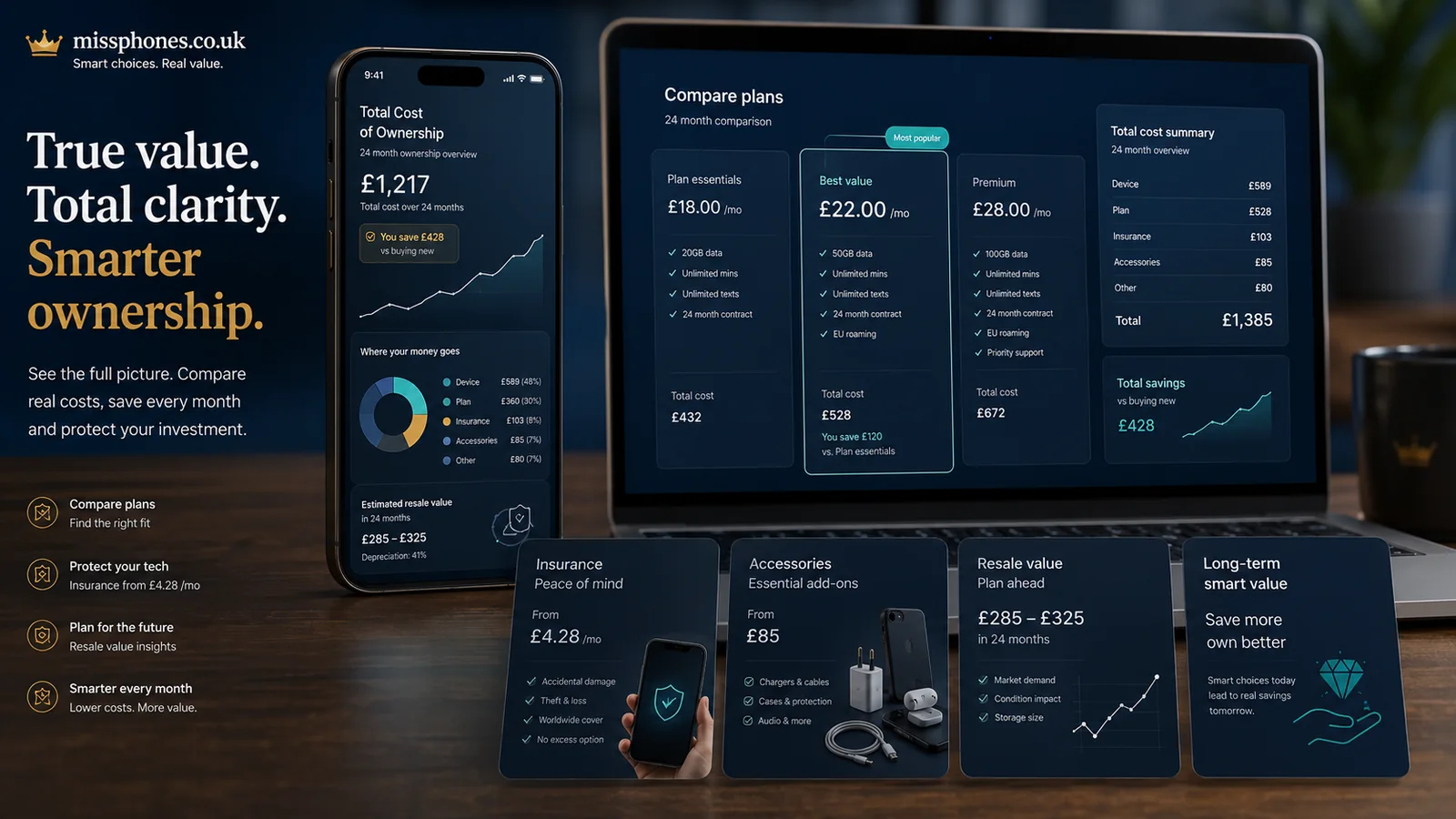
Use the exact same:
- phone model, storage and condition;
- comparison period;
- data and service level;
- network coverage requirement;
- included extras.
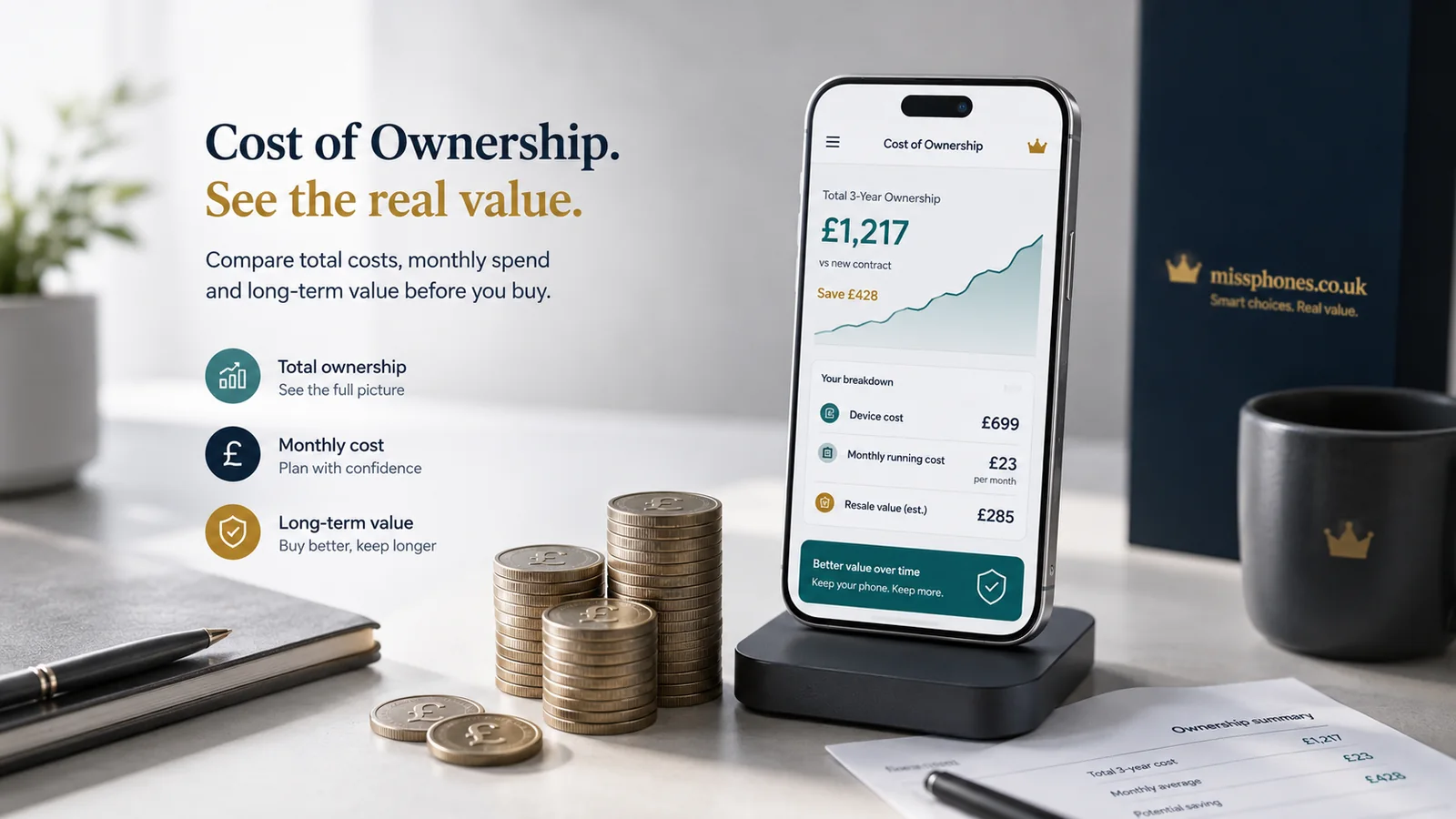
For an outright route, add the handset cash price and every SIM payment over the chosen period. For a contract route, add the upfront amount, every monthly payment, scheduled price rises and any compulsory final payment.
Buying a Phone Outright vs on Contract: illustrative comparison
Illustrative figures only — not current prices.
| Outright + SIM-only | Handset-inclusive contract | |
|---|---|---|
| Initial handset/upfront | £620 | £20 |
| Service/contract payments | 24 × £10 = £240 | 12 × £34 + 12 × £36 = £840 |
| Total over 24 months | £860 | £860 |
| Cash-flow profile | High initial cost | Higher continuing commitment |
In this example the totals happen to match. The decision would then turn on affordability, flexibility, service quality, ownership and exit terms. Real offers may favour either route.
When outright can be stronger
- You can pay without using emergency savings or expensive borrowing.
- You want to switch SIM or network easily.
- You expect to keep the phone beyond a typical contract term.
- The handset has a strong cash discount.
- You value simple ownership and resale.
When a contract can be reasonable
- The full contractual total is competitive for the exact phone and allowance.
- The monthly commitment is comfortably affordable.
- The provider offers suitable coverage and service.
- The agreement clearly explains price rises, ownership and early exit.
- You are not relying on conditional cashback to make it affordable.
Do not confuse convenience with cost
One direct debit is convenient, but a single payment can hide several products. Conversely, buying outright is not automatically cheaper if the phone is bought at a poor price or paired with an unsuitable SIM.
Check the downside
| Risk | Outright route | Contract route |
|---|---|---|
| Phone lost or broken | The purchase cost is already paid | Payments usually continue even if the phone is unusable |
| Need to change network | Usually straightforward with an unlocked compatible phone | Airtime commitment may remain |
| Need cash | More money was spent at the start | Early settlement or exit may be costly |
| Phone becomes outdated | You choose when to replace it | You may still owe payments |
Do not hide borrowing in the outright route
Buying “outright” with an overdraft, revolving credit or another loan is not a cash purchase for comparison purposes. Include the likely borrowing cost and repayment risk. A transparent contract may be cheaper than high-interest borrowing, while genuine cash purchase may be cheaper than both.
Check contract discounts rather than assuming a premium
Some handset-inclusive offers may be subsidised or discounted; others cost more than buying the components separately. Calculate the actual offer. Statements such as “contracts always cost more” or “networks subsidise every phone” are not reliable rules.
Consider how long you will keep the phone
If you normally keep a supported phone for four or five years, a two-year outright-plus-SIM comparison should also show service costs after month 24. If you replace phones frequently, include depreciation and any remaining finance rather than assuming an easy resale.
What happens after the minimum term?
With an outright phone, only the chosen service plan may continue. With a contract, establish whether airtime rolls on, whether device payments end separately and whether a better tariff becomes available. Do not leave a completed device commitment hidden inside an unchanged monthly bill without checking the provider’s documents.
Practical decision
Reject any comparison that does not show a full total. If the totals are close, choose using affordability, flexibility and verified coverage rather than the marketing label.
Continue with SIM-Only vs Handset-Inclusive Contract and the the detailed contract-cost guide.