Company-issued phones and Bring Your Own Device solve different problems. BYOD can reduce immediate hardware spending, but it transfers device choice, ownership and part of the support burden to employees while increasing the difficulty of separating corporate control from personal privacy.
Compare lifecycle cost, not purchase cost
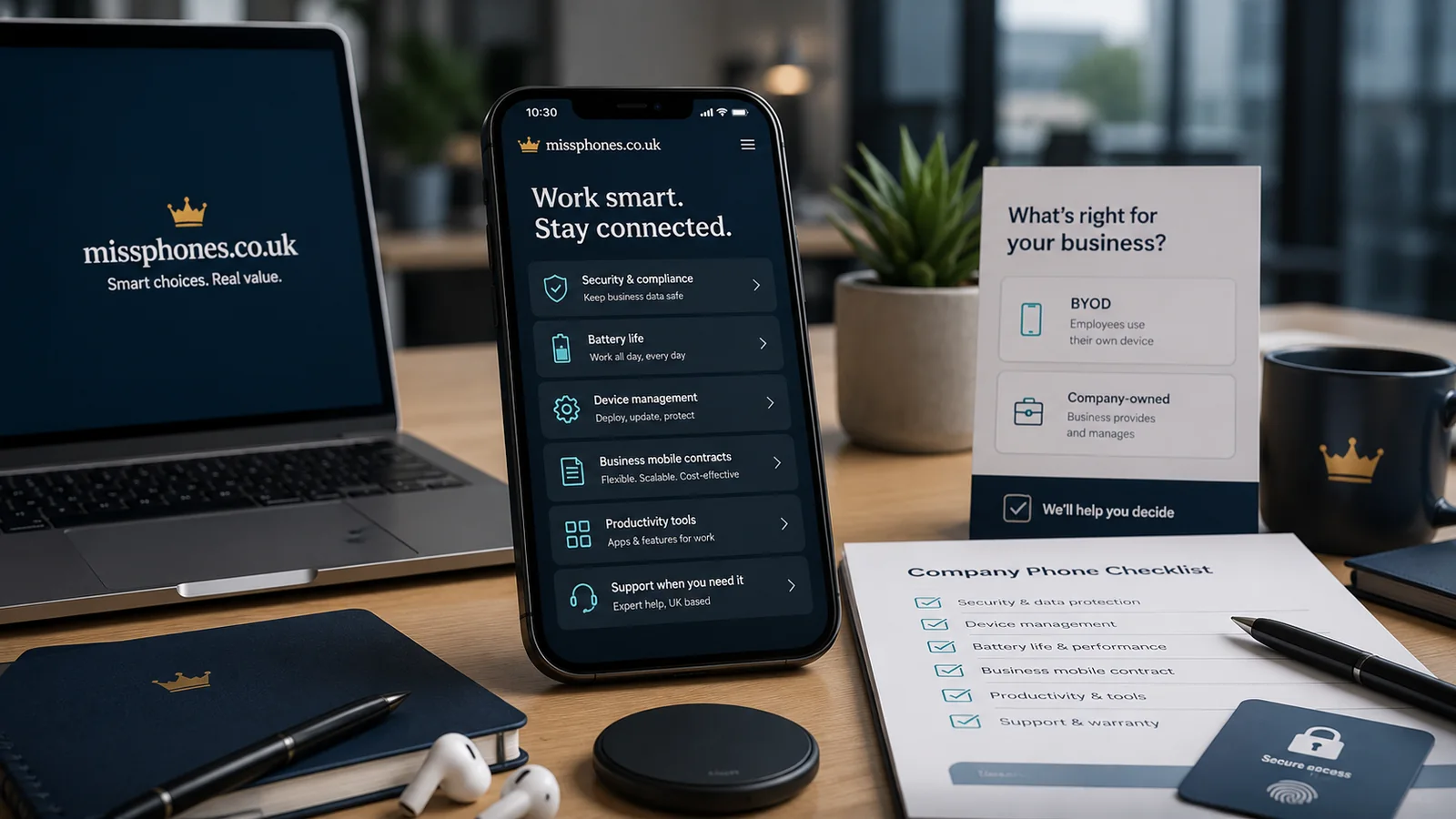
| Factor | Company phone | BYOD |
|---|---|---|
| Hardware | Organisation buys, finances or leases | Employee owns the device; organisation may reimburse or pay an allowance |
| Management | More consistent and usually easier to enforce | Must work across personal models and agreed management boundaries |
| Privacy | Clearer business ownership, but personal use still needs a policy | Higher risk of conflict between corporate controls and personal data |
| Support | Standard models and spares are easier | Wider range of devices, versions and failure modes |
| Offboarding | Return, wipe and reassign the asset | Remove corporate data without erasing personal information |
| Residual value | Belongs to the organisation | Belongs to the employee |
BYOD needs a written design
NCSC guidance treats device management as the central question. Decide:
- which roles and data may use BYOD;
- minimum supported operating-system and patch level;
- whether a work profile, managed app or full-device management is used;
- what the organisation can see and remotely remove;
- how lost devices and incidents are reported;
- who pays for data, repair and replacement;
- what happens when employment ends.
Protect personal privacy as well as company data
A BYOD policy should explain monitoring, logging, location, backups and remote wipe in plain language. Full-device control over a personally owned phone can be disproportionate where a managed work profile or remote application would meet the need.
The ICO's current BYOD page is under review following the Data (Use and Access) Act, so organisations should recheck updated data-protection guidance before implementation.
Tax and reimbursement are not interchangeable
HMRC distinguishes an employer-provided phone under a contract between employer and supplier from money paid to an employee for using their own phone. Do not assume the same tax treatment applies. Ask payroll or tax advisers to review stipends, reimbursement and mixed private use.
Choose company-issued phones when
- the role handles sensitive or regulated data;
- rapid offboarding and remote response are essential;
- specialist apps require controlled models;
- the organisation needs predictable support and spares;
- personal-device management would be intrusive.
Choose BYOD only when
- the business need and eligible roles are defined;
- supported devices can be verified;
- corporate data can be separated and removed safely;
- employees understand the controls and costs;
- there is an alternative for people who cannot or do not wish to use a personal phone.
Related guidance: For the wider buying decision, use Buying a Phone. The Complete Phone Buying Guide brings the main costs, checks and trade-offs together.
Sources checked
Information checked on 26 July 2026. This is general UK guidance, not legal, tax or security advice. Terms, complaint routes and platform features can change, so confirm the current wording before acting.