A business phone should reduce interruption and protect work data. Start with security support, required apps, device management, battery endurance, repair continuity and ownership. Tax treatment should be confirmed from current HMRC guidance or a qualified adviser rather than inferred from the product description.
Define the work requirements
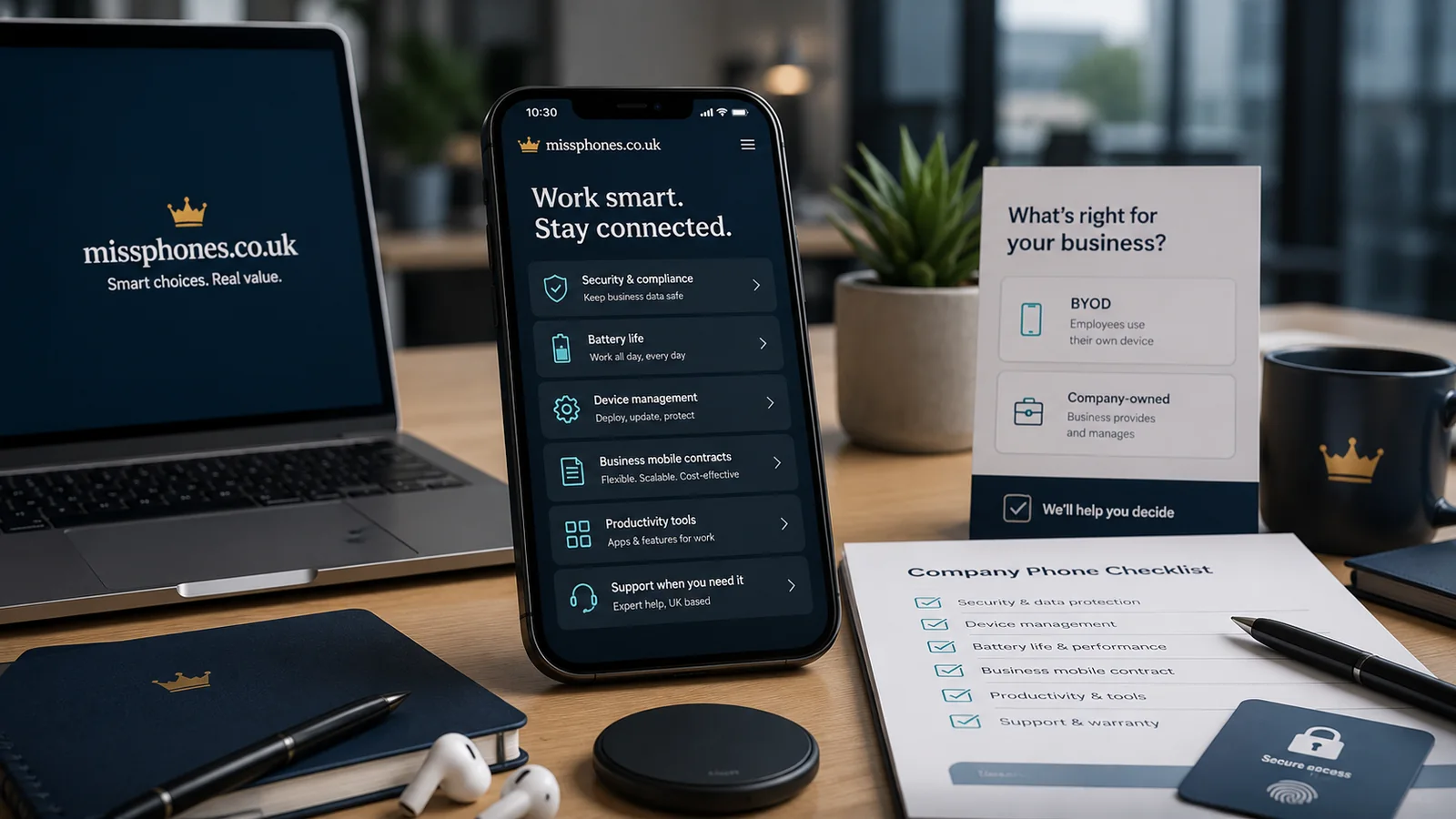
| Requirement | What to verify |
|---|---|
| Business apps | Exact operating-system and hardware requirements |
| Security | Published update period, encryption, biometric options and remote management |
| Travel | SIM/eSIM compatibility, roaming terms and repair support in relevant countries |
| Continuity | Battery replacement, same-day repair, spare-device process and backup |
| Field work | Brightness, case ecosystem, ingress resistance and glove or stylus needs |
Separate ownership from use
Decide whether the employer or individual owns the phone, who signs the airtime and finance agreements, who may wipe the device and what happens when employment ends. For bring-your-own-device arrangements, the business should define acceptable security, support and data-separation rules before the phone is selected.
Compare cash flow with total cost
Buying outright can simplify ownership. Device finance can preserve cash flow but adds a commitment and may involve credit. Compare the total amount payable, expected useful life, downtime risk and residual value rather than using tax deductibility as a reason to overspend.
Use current HMRC rules carefully
HMRC states that an employer-provided mobile phone can be exempt where only one phone or SIM is provided and the contract is between the employer and supplier. For self-employed people, only the business proportion of mixed personal and business costs is generally claimed. Circumstances vary, so this article is buying guidance rather than tax advice.
Build a downtime cost
The cheapest handset can become expensive if a failure stops work for several days. Estimate the value of a same-day replacement, spare device, local repair or advance replacement service. For a fleet, standardising on a small number of supported models can reduce accessories, training and spare-parts complexity.
Check device-management limits
Confirm that the exact operating-system edition and model support the organisation’s management, security and work-profile requirements. Some consumer variants or imported devices may not fit the policy. Test enrolment before purchasing a fleet.
Record the exit process
- Who removes company accounts?
- Who authorises a factory reset?
- How is personal data separated in a BYOD arrangement?
- Does the employee return the handset, SIM and accessories?
- How is a remaining finance balance handled?
After Choosing a Phone for Business Use, the closest next step is Buying a Phone, then Complete Phone Buying Guide.